Music, the more-than-human and cousin George
Human
I was about 10 years old the last time I saw cousin George. I remember him as this kind of romantic figure in his RAF uniform (the UK still had National Service back then). He was grown up but with an enthusiasm a child could recognize. I remember his motorbike and sidecar in which he once took me to the seaside. I remember he bought me a battery driven Triumph TR3 scale model. He seemed to epitomize modernity and at that time I loved anything modern. I also remember that he played clarinet and, given what I now know about his musical tastes, he may have influenced me more than I remember.
More-than-human?
First Hints
It was Christmas 1976. I was staying with a bunch of friends in a cottage by Loch Rannoch in the Scottish Highlands. I’d just bought a bass clarinet and wanted to practice it but didn’t feel I could do that in the house, so I took the instrument down to the loch and tried to play – jazz, which was my musical life at the time. But I couldn’t play jazz there. It didn’t work in that environment. It was an emotional, almost physical reaction – nothing rational/theoretical about it. I stopped and cleared my head. What then came from my instrument sounded a bit Scottish – unplanned, nothing I’d ever played before – it’s just what happened.
What was out there, what more-than-human life1, was out there that made this happen? Was I part of that? Was a different part of me present than when I played in a smoky club?
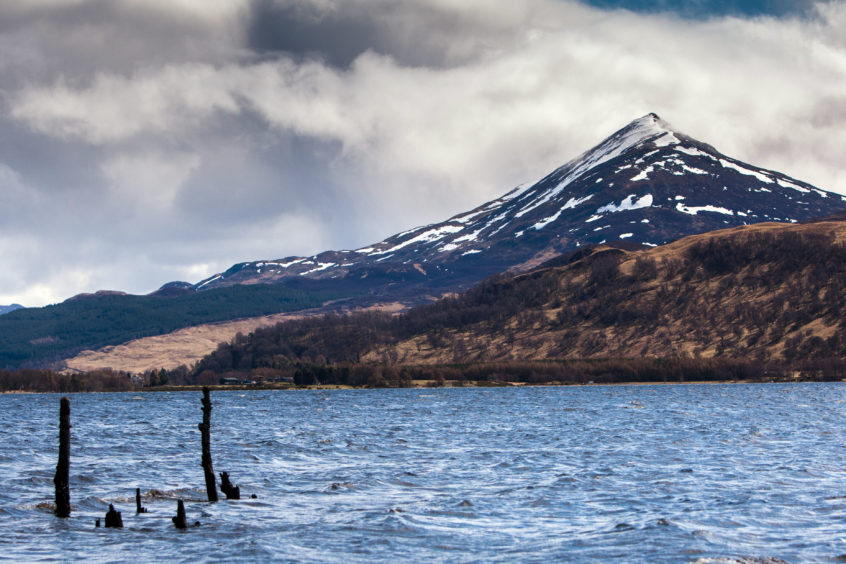
Cousin George (himself a Scot) had been living in New Zealand for 16 years by this time. My parents visited him and his family there a year or so before my Christmas at Loch Rannoch. I remember my mother describing him as a “backwoodsman” – someone who did as much as possible himself with the materials that were available, someone who had an understanding with nature. Nature, rambling, music. We were separated by geography and chronology but somewhere along the line our paths seem to have crossed. At Christmas 1976 I had a long way to go before that crossing but what happened there sowed the germ of something, even if I didn’t properly understand it. If I’d known what I know now, I’d have asked George what he made of it all .
Dawnings
Fast forward to April 2020. There I am making music again in that more-than-human world. I don’t remember having done that in all the years in between. What I had done more recently was to spend time exploring the experience of being a human in a more than human world. What does it feel like to be just one element of that world, not in competition with it, not its owner, not just its admirer. Can we be, as Paula Aamli asked in one of our poetry/music collaborations, at home there? To the extent that anything I do can be called research, I’m as much the subject of that research as any other inhabitant of that world.
Anyway this time I’m playing an instrument I’m comfortable with in what I call “the little wood” behind my partner’s house. I don’t even know why I felt the need to do it then. I hadn’t yet connected music with that more-than-human exploration. I had no idea what I wanted from it, which was probably a good thing. A while before I’d made some field recordings (birdsong, wind, water, frogs, a convoy of trucks) in various spots in the area, intending to record me later playing a sort of duet with them. I never did that, because it felt somehow artificial, so maybe that’s what drove me out into the little wood one Sunday morning – the feeling that I’d be in control of nothing and whatever happened would be an honest exchange in the moment. Cousin George would, I think, have approved.
There was something special about that exercise, so I did it again several times. The little wood is triangular and there are roads on the long sides. Other than at the height of summer I can easily be seen and heard by walkers and cyclists on both sides, so I tended to look for spots where I can hide, and to play very quietly. That the other living beings in the wood themselves can see and hear me is, on the other hand, an essential part of the experience.
Here’s a clip from that first venture into the wood:
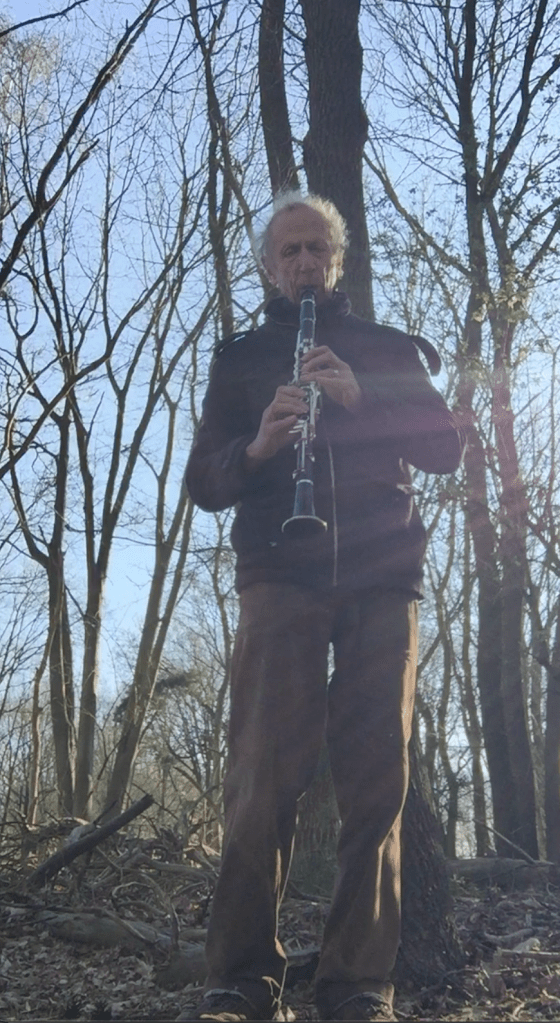
You can see that I’m from time to time very acutely listening to the other sounds around me – specifically birdsong – and that I also struggle a little with finding a balance between just playing music as I might elsewhere and trying out sounds that seem to fit better with what I hear around me.
Ahah
Fast forward another couple of years and there I am in the same little wood with my bass clarinet (remember that?) and suddenly something has changed. I’ve been out there a few times in the years in between with various instruments. I’ve also been out there from time to time doing stuff that needed doing and I’ve been out there just giving my senses full rein – open to everything around but, let’s say, passive. But now, on this particular slightly chilly May morning with this particular instrument, I’m suddenly more at home there than I’ve ever been – free to be myself, to be seen by passing strangers, to play whatever comes into my head without worrying about context, to play around a bit, to acknowledge that there’s a camera there and that I might show this to other people – and somehow also more tuned in to what’s happening around me, to what the other inhabitants of this little ecosystem are doing, than I perhaps ever was.
Here’s a short version of that session:
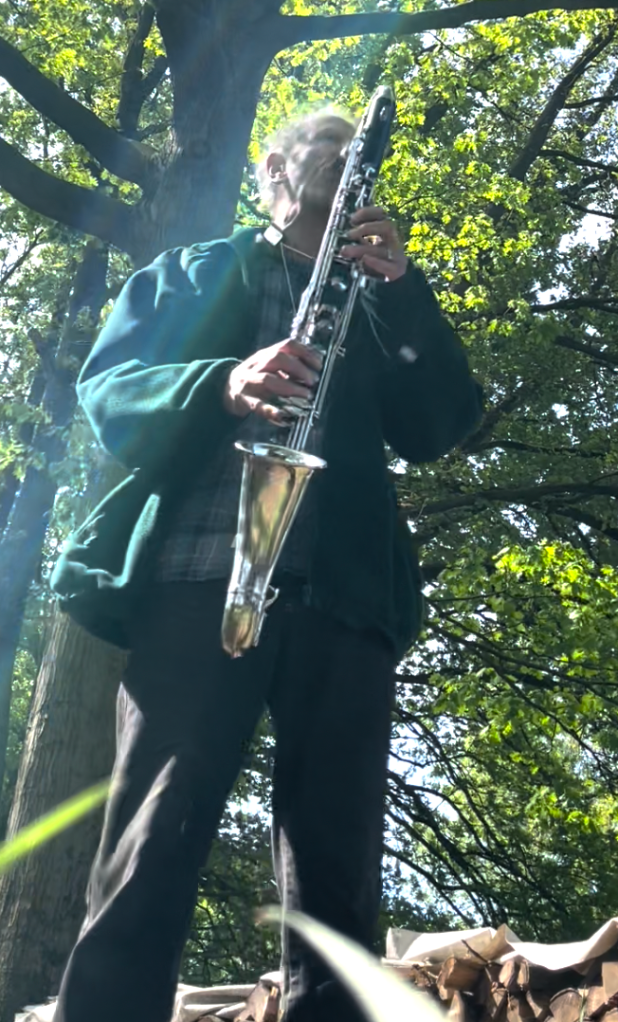
I think it’s better musically than its predecessors, so let’s talk about music and try to understand what “better” might mean.
A little philosophizing about music
Improvisation
As a musician, I’m an improviser. The interaction out there in the wood is improvisational. How all the participants react to each other or choose not to, is of the moment. Each of us present there, is being who we are, behaving as we do in that place. Each of us may or may not let our behaviour be influenced by some or all of the others. I don’t know to what extent that, for any of the non-humans present, is a conscious choice but I do know that whatever each of us does or does not do (including being silent for a while) is part of the music.
What Is “Music” For Me?
Much of what I do on my instruments these days consists of sounds, which are not the regular musical notes those instruments were designed to produce2. In fact it’s something that has occupied me from time to time throughout my musical life but recently it’s become more confident and mature. Those sounds today seem to have two origins. One is those I’ve heard “outdoors” in the various more-than-human worlds, in which I’ve immersed myself over the last few years. These sounds have subsequently migrated “indoors” and become part of my playing there. Other sounds, discovered and developed “indoors” in the past, have migrated the other way. Some of those, despite being more abstract in origin, also feel comfortable outdoors. But then, who knows where they came from anyway? Maybe they made their way into my head from some other, unrecorded source and nestled in my subconscious until their moment arrived.
So what is “Better”?
That’s a difficult question posed recently by a friend to herself about her poetry. What is, for me, “better” improvisation? It starts with whether I enjoyed what I was doing, while I was doing it. “Enjoyed” for these purposes includes being moved, touched, surprised.
And then there’s the quality of listening. Listening or, more meaningfully, what Pauline Oliveros has called Deep Listening – is fundamental to the success of improvisation. The depth of our listening is the extent to which we immerse ourselves in the totality of what’s going on. The deeper we listen, the more what happens in the moment will deliver creative surprise – magical moments. The result is a coherence, which is emergent, because it was not discussed in advance.
So when I wrote that this piece, which I called, with a nod to Pink Floyd, Games for May3, was “better musically than its predecessors”, I suppose that’s how I was judging it. That is of course a judgement after the event, so it includes enjoying the recorded result. It includes the feeling that the whole thing hangs together, is indeed coherent – more than just a collection of unrelated sounds. That’s not the same as structure. There’s no structure as such: no theme, development, reiteration or suchlike; no obvious start and end point and there was no intention of that sort.
Cousin George
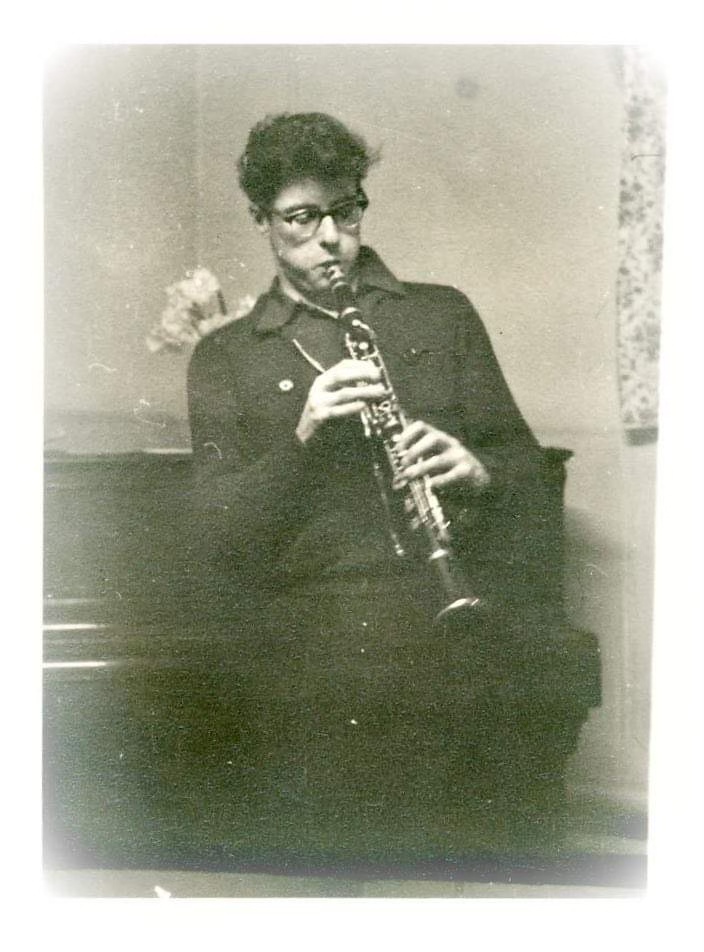
The George who took me to Blackpool with his motor bike was the same man my mother described as a “backwoodsman” – the man who could make stuff, the man who tried to be as close to nature as he could. His daughter, Alison, confirms that. He loved being out in nature – being in nature – in “the bush”, as they say over there – a term that says, I believe, more than “nature”, if only because it doesn’t carry that “us/them” relationship. He took the kids out with him as much as possible. He loved playing his clarinet and saxophone. So, when Alison saw the first of my recent little wood videos, she thought immediately of her dad and how much he would have loved to do that.
Somehow this struck enough of a chord in me that everything I do in that space is now dedicated to George. How I wish he could have taken me out into his woods and mountains.
(Not a) Conclusion
This has been a story, a presentation of some experiences and the feelings they evoked. It’s an attempt to show the experience to you rather than just tell you about it.
Thinking and writing about those experiences has given rise to some what you might call conclusions – things I may have learned that can be expressed in a propositional form. It’s also made me more conscious of the relevance of other engagements and collaborations – entanglements. The propositional form is not the purpose of this post but I may put it in another post. I probably will.
Nonetheless those “conclusions” will go with me and will (consciously or not) influence what I do and in that sense be tested. And that will happen in the little wood or in some other more-than-human place and also in my musical engagement with other humans.
And cousin George will be watching
Notes:
1. I wasn’t aware of this term and probably wouldn’t have understood it back then but the feeling was real. What I mean by more-than-human is a world, in which the value of everything non-human is not determined by its use value to us. A world in which we understand ourselves as part of nature, not occasional visitors to it. We are equal participants – no more, no less. Logically, that seems staringly obvious but getting to the point at which we (or I at least) actually feel that we are at home there, is a process.
I learned and grew to understand the term from a masters education in sustainability and responsibility. My final year project was (partially) a first step towards the role music might play in a sustainable and responsible world. I guess I’m still exploring that project.
2. I play more regular music too but that’s (probably) not relevant here.
3. From See Emily Play (1967)

 Being Somewhere
Leave a comment